
When comparing OpenClaw vs n8n, the wrong question is often asked. This isn't a feature shootout. It's a choice between deterministic workflow automation and autonomous agent execution, a distinction described directly in this OpenClaw vs n8n breakdown. That sounds abstract until you operate either one in production. Then the difference shows up in retry behavior, auditability, blast radius, access control, and who gets paged when something drifts.
The surprising part is that the biggest failure point usually isn't capability. It's governance. Teams often prove an agent can do the task, then run into the actual blockers later: separate environments for clients, scoped permissions for operators, billing visibility, and a security boundary strong enough for legal and compliance review. That's where superficial comparisons fall apart.
Here's the short version.
| Dimension | OpenClaw | n8n |
|---|---|---|
| Core model | Autonomous AI agent | Deterministic workflow automation |
| Best fit | Open-ended tasks that require judgment | Repeatable processes with defined steps |
| Execution style | Chooses its own path to a goal | Follows the path you design |
| Operational strength | Flexible reasoning | Predictable orchestration |
| Cost pressure | Tends to grow with LLM API usage | Tends to grow with execution volume |
| Common scaling concern | Non-determinism, isolation, oversight | Queueing, worker management, workflow sprawl |
| Team challenge | Multi-instance governance | Workflow governance at scale |
| Strongest pattern | Agent layer inside a broader stack | Backbone for business automation |
Table of Contents
- The Real Choice Between OpenClaw and n8n
- A High-Level Overview of Each Platform
- Core Architecture and Capabilities Compared
- Governance Security and Multi-Tenancy
- Pricing Models and Total Cost of Ownership
- Practical Use Cases for Every Team
- Decision Checklist Which Tool Should You Choose
The Real Choice Between OpenClaw and n8n
Feature lists blur the actual decision. OpenClaw and n8n were built from different assumptions about how automation should work. One assumes you can define the path up front. The other assumes you often can't.
That distinction matters because production systems punish ambiguity. If a finance process, data sync, approval path, or handoff must behave the same way every time, a workflow engine fits the job. If the task starts with a messy goal like triage this inbox, research this market, or decide what follow-up makes sense, agentic execution can be the better fit.
Practical rule: If you can draw the process on a whiteboard with a reliable step order, start with n8n. If the order depends on what the system discovers along the way, OpenClaw starts to make sense.
CTOs usually discover this after a pilot. The pilot works. Then the questions get harder. Who can change prompts or workflows? How do you separate client data? What logs exist for post-incident review? How do you stop an autonomous tool from touching the wrong system with the wrong credentials?
Those questions aren't edge cases. They are the operating model.
A useful way to think about OpenClaw vs n8n is this:
- n8n is an orchestration layer for known processes
- OpenClaw is a reasoning layer for unknown paths
- Operations decides whether either one survives contact with real governance requirements
A High-Level Overview of Each Platform
n8n as a process engine
n8n works like a digital assembly line. You define triggers, steps, conditions, transformations, and actions. It's well suited to tasks like invoice handling, data sync, notifications, and approval logic because those processes benefit from consistency.
In practice, n8n shines when a team wants to make a process visible and controllable. An operator can inspect the workflow, understand the path, and reason about failures without reconstructing an AI system's internal choices. That alone matters more than many buyers realize.
A workflow tool also changes the staffing model. You don't need every automation owner to think like an ML operator. You need people who can define business logic, connect systems, and manage exceptions.
OpenClaw as an agent runtime
OpenClaw behaves more like an AI employee than a workflow builder. You give it a goal, context, and tools, and it determines the steps needed to complete the task. That's why it fits open-ended work where the exact path can't be fully specified in advance.
This is the core of the platform category. You're not modeling every branch manually. You're creating a bounded environment where an agent can reason and act.
For teams exploring managed deployments, Donely's OpenClaw platform is one example of how that model gets operationalized with hosted instances and governance controls, rather than leaving every team to self-manage the runtime.
Open-ended work is where static workflows start to look brittle. The challenge is that autonomy also creates a wider operational surface.
That wider surface changes how you review risk. With OpenClaw, you need to think about prompt scope, tool permissions, instance isolation, data exposure, and fallback handling. The question isn't whether the agent is capable. It's whether the environment around it is mature enough for production use.
Core Architecture and Capabilities Compared
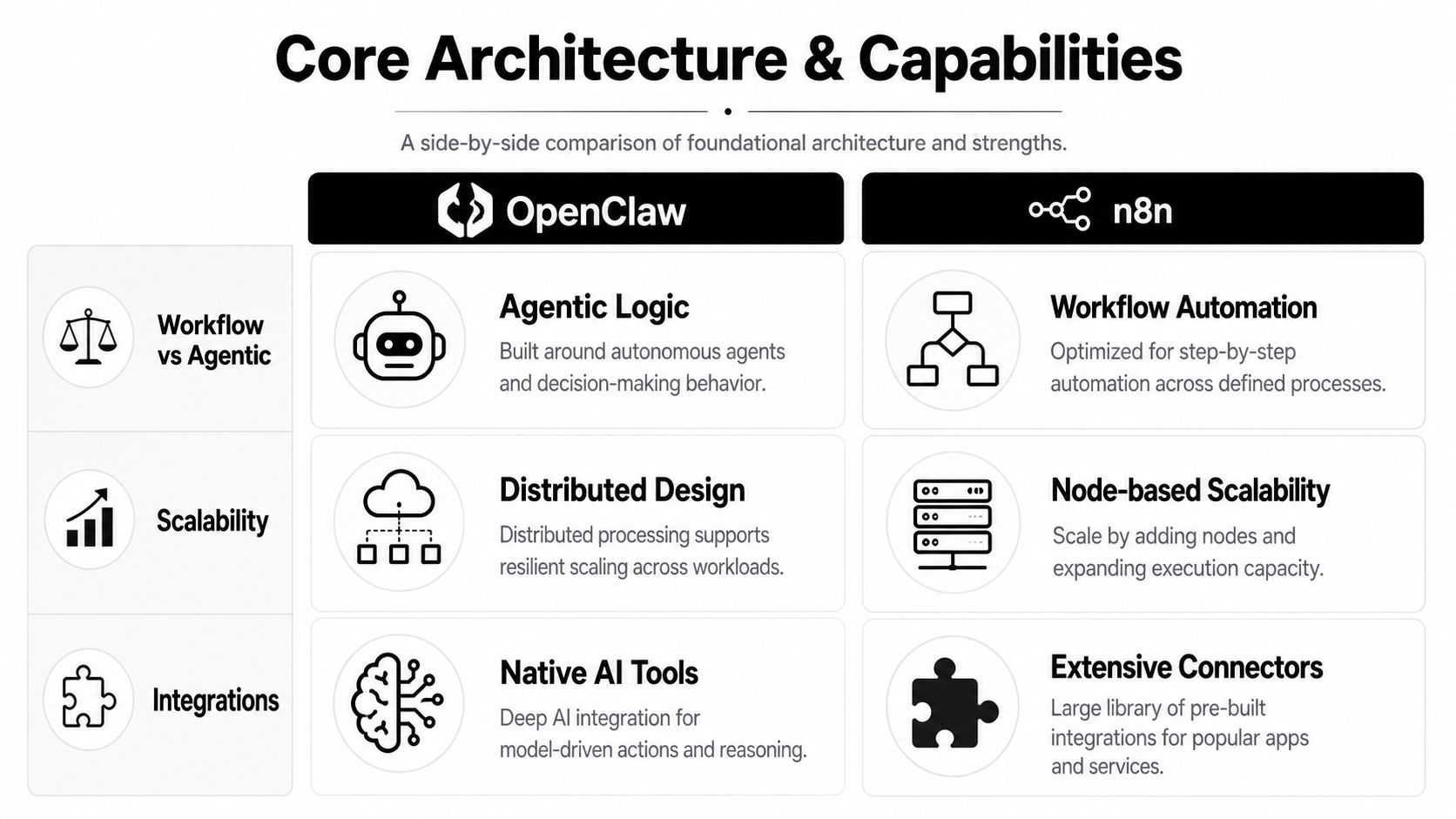
How each system thinks about work
Architecture decides what will break first at scale.
n8n is built around explicit workflow orchestration. OpenClaw is built around goal-driven agent execution. That difference shapes everything that follows, from testing discipline to incident response to who owns production changes.
With n8n, the builder defines the path in advance. Trigger, branch, transform, send, retry, update. Operators can inspect the exact sequence because the sequence is the system. Predictability is the main advantage, especially for teams that need repeatable outcomes and clear runbooks.
With OpenClaw, the operator defines the objective, available context, and toolset. The system determines the path at runtime. That gives the platform more reach on ambiguous tasks, but it also shifts effort into guardrails, validation, and post-run review because intermediate decisions are part of execution, not design.
That trade-off shows up quickly in production.
| Architecture concern | OpenClaw | n8n |
|---|---|---|
| Path control | Dynamic at runtime | Predefined by the builder |
| Repeatability | Lower by design | Higher by design |
| Audit clarity | Requires interpretation of agent decisions | Direct workflow trace |
| Exception handling | Depends on boundaries, tool limits, and review flows | Encoded in workflow logic |
| Best operator mindset | AI runtime operations | Process and integration operations |
Integration philosophy
n8n treats integrations as steps in a controlled process. You connect systems, map fields, define conditions, and move data through a known route. That model fits finance ops, RevOps, internal IT, and back-office automations where consistency matters more than improvisation.
OpenClaw treats integrations as tools an agent can call while pursuing a goal. That is more flexible, but it changes the control point. The hard problem is no longer just "does the connector exist?" It becomes "under what conditions can this agent use this system, with which credentials, against which data, and how do we review that action later?"
For platform teams, connector count is rarely the deciding factor. Integration intent is.
- n8n integrations make business logic explicit
- OpenClaw integrations expand what an agent is allowed to do
- Your operating model decides whether that flexibility stays contained
If your stack spans many systems, integration management across business tools becomes an architecture concern because permissions, ownership, and support boundaries tend to sprawl before the automation logic does.
Deployment reality
Deployment discussions often stay too close to setup speed and subscription price. That misses the actual cost curve.
n8n usually grows into an internal automation service. As adoption spreads, teams deal with worker capacity, queue behavior, workflow versioning, credential hygiene, environment promotion, and ownership between business builders and platform engineers. Those are familiar problems. They still require discipline, but the failure modes are easier to reason about because the execution path is declared up front.
OpenClaw grows differently. What starts as an interesting agent pilot can turn into an estate of agents, tools, prompts, model dependencies, and environment-specific policies. At that point, the expensive work is not creating one useful agent. The expensive work is controlling many of them across teams without mixing data, overexposing tools, or losing visibility into why something acted the way it did.
That is the operational split CTOs should pay attention to. n8n asks whether your organization can manage workflow sprawl. OpenClaw asks whether your organization can operate bounded autonomy safely.
Governance Security and Multi-Tenancy
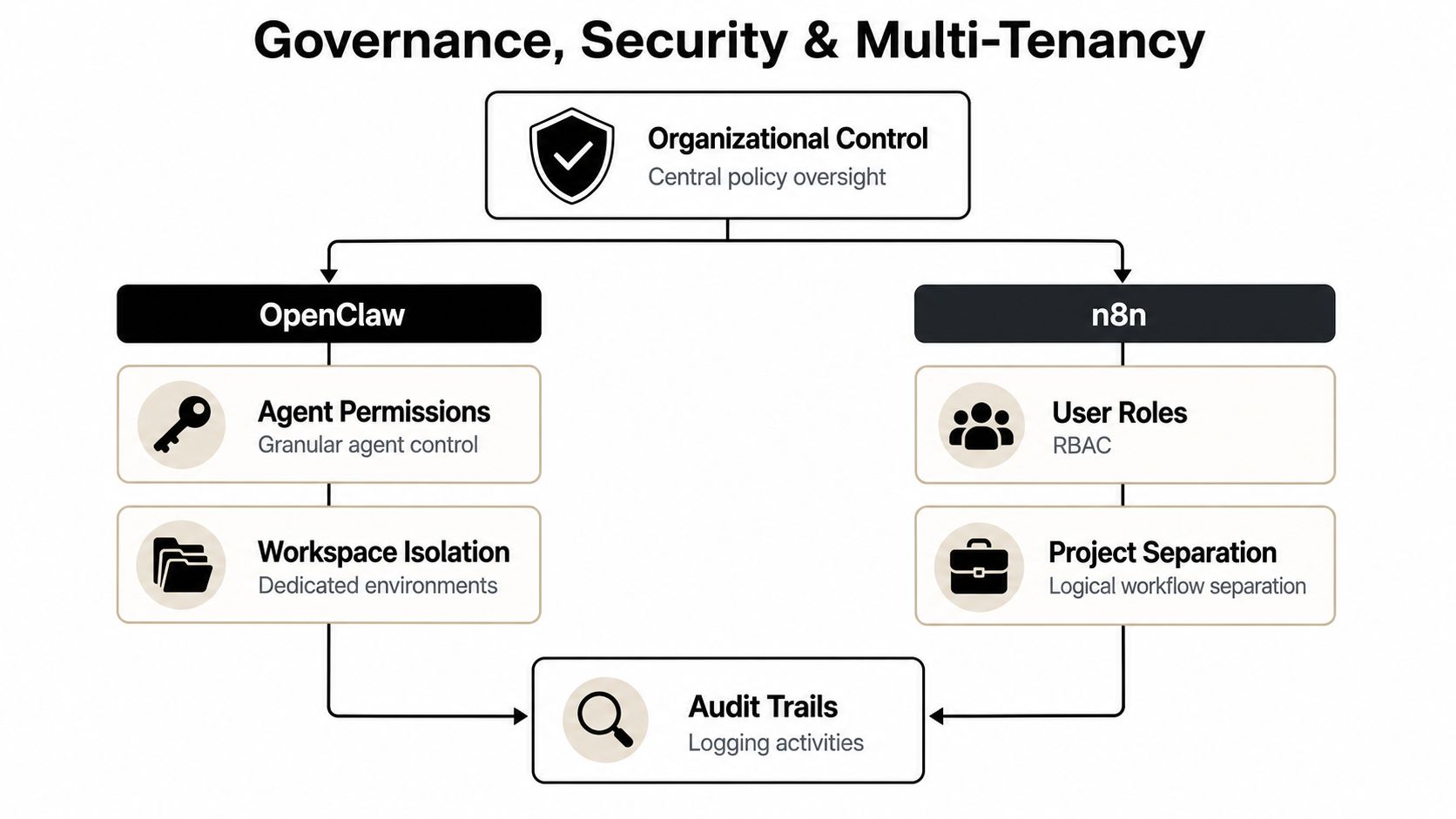
Where governance gets hard
Most comparison pieces skip the question that procurement and platform teams care about first. What happens when one company needs separate instances, scoped permissions, audit logs, and centralized billing across personal, client, and enterprise workloads? That gap is called out directly in this analysis of the missing ops discussion.
That's the point where OpenClaw vs n8n stops being a builder discussion and becomes an operating model discussion.
For n8n, governance problems often show up as workflow sprawl. Too many automations. Too many credential sets. Too many people editing production logic. The answer is usually better role separation, naming discipline, change control, and environment hygiene.
For OpenClaw, governance problems show up earlier around containment. Teams need answers to questions like these:
- Who can create or modify agents
- Which tools each agent can access
- How data is isolated by client, team, or department
- Where logs live and who can review them
- How billing and ownership roll up across multiple deployments
Security boundaries that matter in practice
Security for deterministic workflows is different from security for autonomous systems. With n8n, the workflow itself provides a form of control. You can review the path and restrict what gets executed.
With OpenClaw, the critical controls sit around the runtime.
A senior ops team usually cares about four layers:
Identity boundary
The agent needs a distinct identity, not shared credentials spread across teams.Permission scope
Tool access should be narrow. Broad agent access is easy during a demo and hard during an audit.Data isolation
Personal, business, and client workloads should not share the same blast radius.Audit trail quality
Logs must support incident review, access review, and operational troubleshooting.
If you can't explain the boundary between one client's agent and another client's data in a single sentence, the architecture isn't ready.
Multi-client operations
Agencies and enterprises feel the pain first. A solo builder can tolerate a loose setup. A multi-client team can't.
Shared instances create messy failure modes. One client's credentials leak into another workflow. Billing becomes a spreadsheet problem. Permissions become informal. Troubleshooting turns political because no one knows who changed what.
That's why managed OpenClaw operations often need multi-instance architecture, per-instance RBAC, isolated containers, scoped data access, and unified audit logs. Those aren't marketing extras. They are the controls that let an agent platform function inside a real organization.
n8n has an easier time in environments where the business process itself is already structured. OpenClaw needs stronger operational guardrails because the runtime is more flexible.
Pricing Models and Total Cost of Ownership
Sticker price is the easy part
Published entry pricing makes the first pass look simple. OpenClaw managed hosting can start low, and n8n Cloud also starts at a modest monthly tier. That comparison matters less after the pilot stage.
The primary cost driver is what each platform meters. n8n usually gets more expensive as execution volume rises. OpenClaw usually gets more expensive as model usage, context size, and agent activity rise. The cheaper option depends on the workload shape, not the homepage price.
For repetitive, high-volume workflows with predictable steps, n8n often produces cleaner unit economics. For lower-volume work that replaces human review, research, drafting, or triage, OpenClaw can justify higher per-task cost because the alternative is labor, not another API call.
Procurement teams should also evaluate these tools the way they evaluate adjacent systems such as product management tools for modern teams. License cost is only one line item. The bigger question is whether the platform fits the operating model you will have a year from now.
The hidden DevOps bill
Self-hosting shifts cost from software spend to internal labor.
With n8n, that labor usually shows up in upgrades, backups, queue tuning, worker capacity planning, secret rotation, and general platform maintenance. Those are familiar platform problems. Many infrastructure teams already know how to run them.
With OpenClaw, the work is less routine and often more expensive. Teams end up building policy around the runtime itself: model access controls, prompt and credential handling, observability for agent behavior, failure review, tenant isolation, and safe deployment patterns for AI-driven actions. The open source core may be usable quickly, but operating it safely across teams or clients is where cost starts to climb.
This is the part buyers miss. A platform can be cheap to start and expensive to govern.
That gap is exactly why managed options matter. OpenClaw pricing and hosted instance options are relevant because they convert part of that engineering overhead into a defined service boundary, which is often the difference between a successful rollout and a stalled internal platform project.
Practical Use Cases for Every Team

Founders and small teams
A founder usually shouldn't start by asking which platform is more powerful. The better question is which one removes the next operational bottleneck.
If the work is onboarding emails, CRM handoffs, internal alerts, and routine reporting, n8n fits because the process is known. If the work is inbox triage, lead research, or first-pass customer reply drafting, OpenClaw fits because the task needs judgment.
Small teams find their greatest advantage when they avoid forcing one tool to act like the other.
Agencies and consultants
Agencies hit governance pain faster than startups. They don't just need automation. They need separation.
A common pattern looks like this:
- n8n generates structured client reports, routes approvals, and pushes updates into CRM or project tools.
- OpenClaw handles tasks like content ideation, research, or support triage where the path changes by client context.
- Each client environment needs its own credentials, logs, and operator boundaries.
This is why operational design matters more than demo quality. The question isn't whether the agent can produce output. The question is whether your team can operate multiple client workloads without shared blast radius.
Enterprise environments
Enterprises rarely replace orchestration with agents. They layer agents on top of orchestration.
That hybrid pattern is explicitly noted in this discussion of scale limits and hybrid architecture, which argues that the better question isn't which tool is better, but where each breaks at scale. It also notes a common pattern where OpenClaw handles judgment and agentic steps while n8n handles deterministic orchestration, which can reduce token spend and improve reliability.
That maps cleanly to enterprise architecture:
- n8n handles system-to-system coordination, approvals, structured routing, and deterministic control points
- OpenClaw handles research, drafting, triage, classification, and decisions that depend on context
- The handoff between them becomes the core design problem
The strongest production pattern isn't replacement. It's controlled delegation.
In practice, that might mean n8n triggers a workflow from a new support case, packages the relevant context, hands the judgment step to an OpenClaw agent, receives a structured result, then continues the deterministic path for escalation, logging, and downstream updates.
That pattern gives you two things CTOs care about: flexibility where it matters, and control where it must exist.
Decision Checklist Which Tool Should You Choose
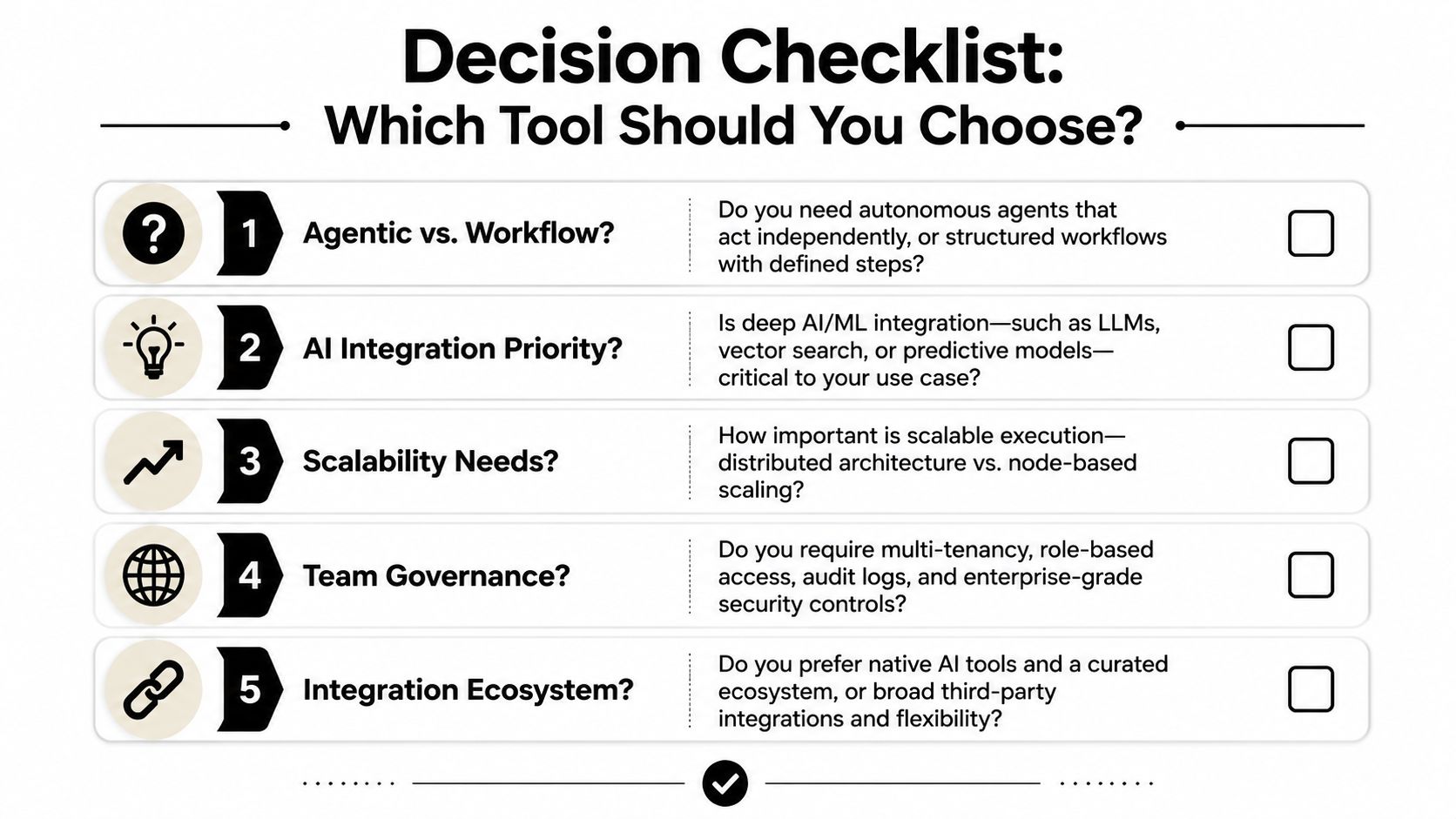
The right answer comes from operating constraints, not vendor positioning.
Choose n8n when
Use n8n if most of these statements are true:
- Your process is known. You can define the path in advance and want it to run the same way every time.
- Auditability matters more than autonomy. You need direct replay of what ran and why.
- The workload is high-frequency. Execution volume is the core scale dimension.
- You need a strong orchestration backbone. The business depends on structured handoffs between SaaS tools and internal systems.
- Your team thinks in workflows. Ops, RevOps, finance, or platform teams already manage repeatable business logic.
Choose OpenClaw when
Use OpenClaw if these statements sound familiar:
- The task starts with a goal, not a flowchart
- The work requires judgment. Research, triage, synthesis, and adaptive action matter more than rigid sequencing.
- You want an agent layer rather than another workflow layer
- The cost driver is reasoning, not just process throughput
- You're willing to invest in containment. Permissions, isolation, logging, and review controls are part of the deployment, not afterthoughts
Choose a hybrid stack when
Many teams land here, and for good reason.
- The process contains both fixed and fuzzy steps
- You want deterministic control points around agent decisions
- You need reliability without giving up flexibility
- You want to limit token-heavy work to the moments that require it
- Your governance model separates orchestration from autonomous execution
A quick self-check helps:
- Can you specify the full path ahead of time?
- Do you need isolated environments for clients or departments?
- Will legal or compliance ask for access boundaries and audit history?
- Does your team have the appetite to self-operate the runtime?
- Is failure more likely to come from process complexity or judgment complexity?
If your answers point toward autonomy but your ops model isn't ready, don't force a raw self-hosted agent into production. Add a managed layer or constrain the agent behind deterministic gates.
A short walkthrough can help frame the criteria visually:
In most real environments, OpenClaw vs n8n isn't a winner-take-all decision. n8n is usually the safer default for repeatable business automation. OpenClaw becomes valuable when the business problem includes ambiguity, judgment, or exploration. The moment you scale that agentic work across teams or clients, governance becomes the deciding factor.
If you need OpenClaw with stronger operational controls, Donely provides hosted agent instances, isolated environments, per-instance RBAC, unified audit logs, and centralized monitoring and billing. That makes it relevant for teams that want agentic automation without building the full governance layer themselves.